Head-Down 405 — Fly sequentials and hybrid formations
version 2026-07-28
Prerequisites
Application
Covers flying documented freefly sequential and hybrid formations: named formations (rodeo, alley-oop, pancake, infinity, and the totem, shorty, stair-step and compressed randoms from the VFS/MFS pools), the mechanics of transitioning between points in a sequence, and the safety of hybrid jumps that mix orientations, including belly.
This is fun-jump and cross-discipline mastery, not a competition-team course; open-class VFS is FFP-HD404. Assumes solid multi-orientation flight from the group and VFS work. Tunnel for the formations that can be drilled; sky for exits, altitude and breakoff.
Regulatory context (worldwide)
Regulations change; each position is quoted with its document edition or date. This is jurisdictional context, not advice on which body is “right”.
- Australia (APF). Head-down and mixed-orientation formation jumps of more than 3 parachutists need a Freefly Crest, Head-Down.
- More than 10 need a Star Crest (OR 9.2.2, 9.1.3).
- Audible mandatory (OR 9.2.3).
- A hybrid that includes belly slots must still meet freefly separation and equipment rules for every flyer. “OR” is the APF Operational Regulations. Follow your federation and drop zone.
Acronym key. APF, Australian Parachute Federation. Op Regs / OR, the APF Operational Regulations. TOM, the APF Training Operations Manual. RBT, the recommended (basic) training tables in the APF Freefly and Angles Guide. RS, the APF regulatory schedules (crest requirements). FFC, freefly crest. CI, chief instructor. DZSO, drop zone safety officer.
USPA SIM, the United States Parachute Association Skydiver’s Information Manual. CSPA, Canadian Sport Parachuting Association.
Pre-requisite units
FFP-HD305 (intermediate VFS) and the head-down group and big-way cards. RPL route: logbook and video of sequential and hybrid jumps against the criteria, plus one challenge jump.
The mixed-orientation problem
What makes a freefly sequential harder than a belly one: belly flyers share a fall rate, so a transition is just horizontal movement and grip changes. In freefly, multiple orientations are in use at once, head-down, head-up, belly, back, each with a different natural fall rate. Every transition can be both a positional change and a fall-rate change, so the coordination compounds. Two rules carry most of the safety:
- Approach angle. Approaching a head-down formation from directly above puts you in its burble (the No-Fly Zone above the feet), where you can be corked out of position into the formation.
- Approach from the side, at the level of the hips, from outside the shoulder-width footprint.
- For a head-up formation the burble is below the feet, the mirror of the same rule.
- Never be below an inverting flyer. A flyer inverting from head-up to head-down accelerates from about 200 to 240–260 km/h in seconds and will close on anyone below.
- Stage orientation changes into clear airspace.
- Do not sit under a flyer who is about to invert.
Formations — say what is documented, and say less where it is not
- Rodeo. The group forms a round, head-up or head-down.
- The round breaks at one point, leaving two end flyers on a linked chain.
- One end flyer moves over the top of the other end flyer’s inside arm, crossing the link, and keeps travelling over the linked arms of each flyer down the chain, pulling the chain along behind.
- The last person finishes by bringing their hand around their head like cracking a whip at a rodeo, which is where the name comes from, and the formation ties itself into a knot.
- Hold levels while the mover crosses each link: every crossing puts one flyer briefly above another’s arms.
- A different jump also called a rodeo, one flyer riding on another’s back, is a separate fun-jump type and is not this manoeuvre.
- Pancake. The formation builds a round, head-up or head-down, then the whole formation flips together to the other orientation, some flyers transitioning through back and some through belly.
- The closest picture is a linked round where everyone does an eagle.
- Key the flip so everyone transitions together.
- The mixed transition paths mean fall rates diverge mid-flip, so grips stay soft and the round’s shape absorbs the wobble.
- MFS competition uses “pancake” for a gripped belly/back pair; that is a different formation.
- Infinity. A round of six or more flyers, crossed in the middle so the docks make a figure-8 seen from the top.
- The signature sequential is the infinity pancaking to round: half the formation flips orientation and the crossed shape opens into a mixed round, half head-up and half head-down.
- Then the other half flips, and the figure-8 returns in the other orientation.
- Fall-rate discipline through each half-flip carries it, and the crossed centre is the reference that holds the shape.
- Totem, shorty, stair-step, compressed. Documented VFS/MFS randoms, a head-up stack (totem), close face-to-face head-down (shorty, compressed), and an offset leg-grip diagonal (stair-step).
- Each has a known burble and a known cork response.
- Build them from the dive-pool documents rather than from memory, and brief the release trigger before the jump.
- Alley-oop. A head-down round splits in half into two semi-circular pieces.
- One piece side-slides anti-clockwise, the other clockwise.
- One piece starts on the inside of the other, then slides past the outside: inside first, then outside, the two pieces passing by each other.
- On completion the pieces rejoin into the round.
- Each piece leader’s line: “towards my counterpart, inside, then outside, then rejoin.” Level discipline is everything while the pieces pass.
- Brief which piece takes the inside lane first, and hold the round’s diameter so the rejoin closes cleanly.
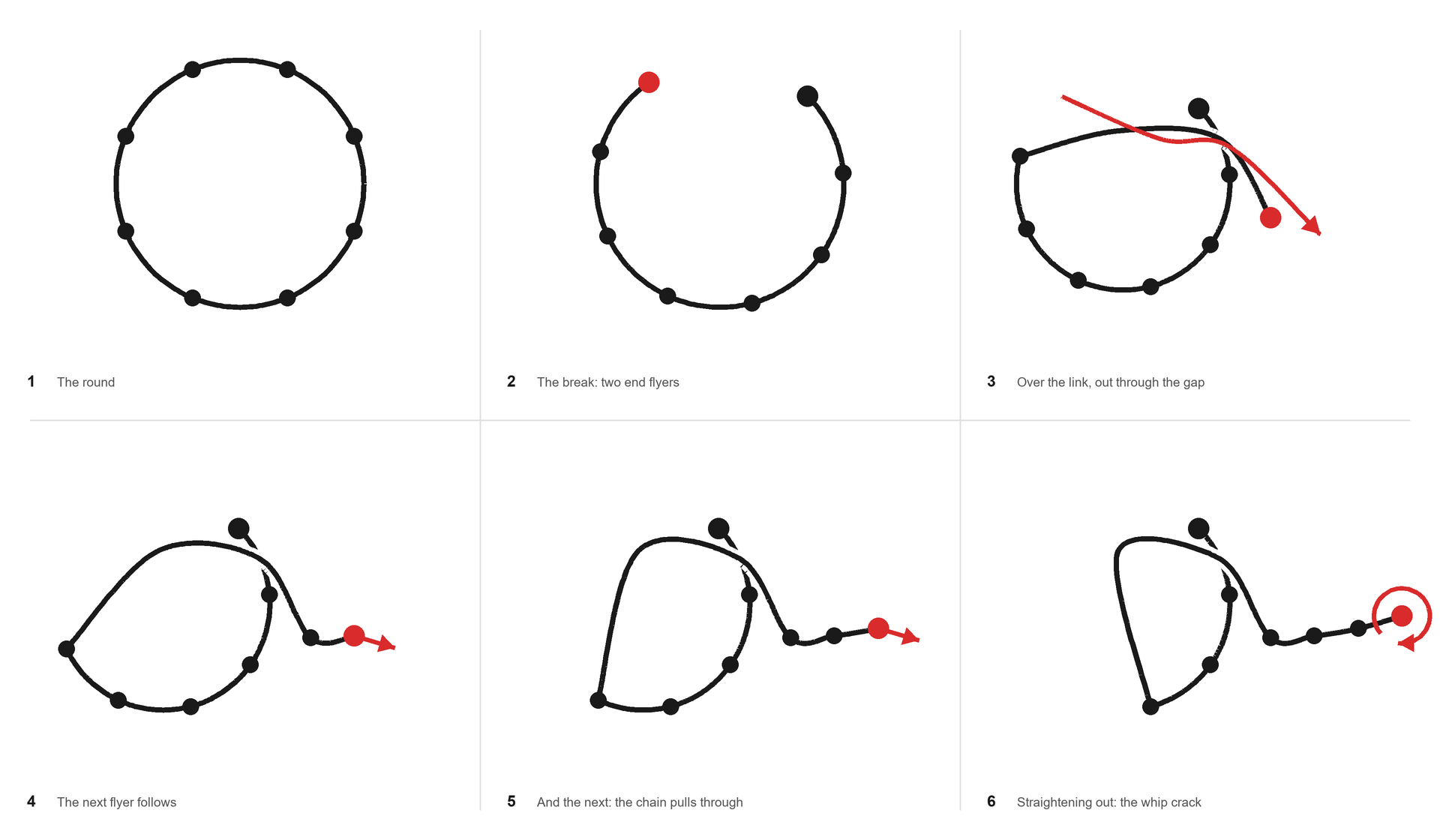
The rodeo in six frames, viewed from above. Black dots are the linked flyers; red is the moving end flyer. (1) The linked round. (2) The round breaks at one point, leaving two end flyers on the chain. (3) The mover crosses the gap and passes over the link between the other end flyer and their neighbour, out through the gap.
(4) and (5) The next flyer follows through the same gap, then the next: the chain feeds through one flyer at a time, pulled behind the mover. (6) The pulled chain straightens out as the last hand comes around the head, the whip crack.
Elements and performance criteria
1. Plan the jump
- 1.1
- State the formation(s) or sequence, own role, the grips and the transition order; for an alley-oop, confirm which piece takes the inside lane first; for a pancake or infinity, confirm who keys each flip; for a rodeo, confirm which end flyer moves and which direction the chain pulls.
- 1.2
- Confirm the exit method (linked where an unlinked approach is unsafe) and each transition's base and mover.
- 1.3
- State breakoff and deployment altitudes and the abort-altitude commitment; sequential and hybrid personal minimums run higher than solo freefly because a formation breakup is more complex.
2. Prepare
- 2.1
- Complete a freefly-specific gear check for every flyer, with hybrid rigs confirmed freefly-compatible and handles clear of gripping hands.
- 2.2
- Dirt-dive each point, each transition and the release trigger, and agree the abort for each position.
- 2.3
- Confirm exit order and separation with the load.
3. Perform
- 3.1
- Build each formation from the safe approach angle, side and below for head-down, never into the feet-side burble.
- 3.2
- Transition between points by holding position, releasing, manoeuvring to the new slot and re-docking at low relative speed, not by tracking away and not by staging an orientation change over another flyer.
- 3.3
- Match fall rate across mixed orientations, bridging the gap with body position rather than forcing the grip.
- 3.4
- Ride out burble interaction with small inputs; on a cork, separate to a stable solo position rather than hold a failing grip.
- 3.5
- Release on the agreed trigger and fly to a stable solo position on any lost formation or spin.
4. Complete
- 4.1
- Initiate breakoff at the briefed altitude (within −0/+300 ft), with each flyer tracking in their own orientation before flattening.
- 4.2
- Check airspace and deploy at the planned altitude.
- 4.3
- Fly the briefed canopy separation plan.
5. Review
- 5.1
- Debrief the sequence against video, locating dropped points, timing errors and any burble or fall-rate mismatch.
- 5.2
- Identify one correction to train next.
- 5.3
- Log the jump naming the unit, the formations flown and the next focus.
Bold criteria are safety-critical, strongly recommended must-meet standards within FFP courses, not regulations. A transition flown over another flyer, a missing release trigger or a low breakoff in a mixed-orientation stack endangers more than the flyer, so a Not Yet Satisfactory on a bold criterion makes the unit Not Yet Competent.
Foundation skills
Multi-orientation flight with fall-rate control in each orientation. Reading and briefing loosely-defined community formations before flying them. Managing a formation breakup by transitioning to a stable solo position and deploying.
Performance evidence (suggested sufficiency — adjust locally)
A guide, not a gate. A record of sequential and hybrid jumps across a range of the documented formations, at small group sizes first, with consecutive jumps flown and broken off to plan. Tunnel evidences the formations that can be drilled; it cannot substitute for exits, altitude awareness or breakoff.
Knowledge evidence
- Explain why a freefly sequential is harder than a belly one (multiple orientations, so transitions change both position and fall rate).
- Explain the safe approach angle for a head-down formation (side and below, never into the feet-side burble) and the head-up mirror.
- Explain why you must never be below an inverting flyer, and how orientation changes are staged into clear airspace.
- Describe the full sequence for at least two of the documented sequentials (rodeo, pancake, infinity, alley-oop): the build, the moves in order, the key or trigger for each move, and the discipline that holds it together (levels for a rodeo, a together-flip for a pancake, piece lanes for an alley-oop).
- Describe the burble and the cork response for the VFS/MFS randoms flown from the dive-pool documents.
- Explain why sequential and hybrid personal minimums run higher than solo freefly (formation-breakup complexity), and the release-trigger discipline.
- Describe the alley-oop sequence from either piece leader’s perspective: split the round, slide towards the counterpart, inside lane, then outside, then rejoin.
Assessment conditions
Sky and tunnel. Real formations are required for the Perform criteria that build points with others; tunnel evidence is preparatory. Sky jumps from a recommended 12,000 ft minimum, higher for larger or mixed-orientation builds. Video is the primary debrief and evidence tool. Equipment: visual altimeter, functioning audible, AAD recommended, freefly-compatible gear for every flyer including belly slots.
Assessor: a freefly coach current in sequential and hybrid flying, using the published FFP-HD405 checklist. Each criterion Satisfactory / Not Yet Satisfactory; unit Competent / Not Yet Competent, recorded as a milestone.
Regulatory context
Australia: APF Freefly Coach; elsewhere: national or drop-zone equivalent
Acronym key. APF, Australian Parachute Federation. Op Regs / OR, the APF Operational Regulations. TOM, the APF Training Operations Manual. RBT, the recommended (basic) training tables in the APF Freefly and Angles Guide. RS, the APF regulatory schedules (crest requirements). FFC, freefly crest. CI, chief instructor. DZSO, drop zone safety officer.
USPA SIM, the United States Parachute Association Skydiver’s Information Manual. CSPA, Canadian Sport Parachuting Association.
Coaching priorities
Deliver in the project’s priority order: Safety → Fun → Learning (curriculum Part A0). These are fun jumps with real hazards, the approach angle, the release trigger and the higher breakoff are non-compensable, and calling a move off because its mechanics were not agreed is a correct decision. Debriefs run without blame and end on a win with one focus for the next jump.
RPL evidence set
For experienced sequential and hybrid flyers the flying is the evidence. Logbook and video of sequential and hybrid jumps showing safe approach angles, clean transitions and orientation-aware breakoffs; a word from a recognised coach or organiser. A challenge jump against this checklist completes the picture.
Sources
The evidence behind this unit
- The formation entries (rodeo, alley-oop, pancake, infinity, totem, shorty, stair-step, compressed, mixed round), the sequential-transition mechanics, and the terminology note on unsettled names.
- Base/movers, No-Fly-Zone approach angles, release-and-track, never-below-an-inverting-flyer, higher sequential minimums.
- 2026-07-28 systematic web sweep with the corrected definitions in hand: no published source (magazine, event report, glossary, competition ruleset, or video) documents the rodeo, pancake, infinity or alley-oop mechanics as defined here.
- Confirms the four entries are first written treatments.
- Closest prior art: Eurosequentials 2010/2011 “infinity shaped formation” (Bad Lieutenants), different mechanics.
- Head-down official-sources research, OR 9.1.3, 9.2.2(c), 9.2.3; APF006 §3.2–3.3.
- Learning-frameworks research §7, unit template, non-compensable safety criteria, RPL design.
Suggest a change to this page open
Spotted an error, or know something that would make this page better? Tell us. The Freefly Project is built to be improved by freeflyers everywhere.
The coaching priority stack
Safety → Fun → Learning
Every course, jump card, briefing and debrief is designed and delivered in this order. Coaches hold it under pressure: never trade safety for fun, never trade fun for learning throughput.
- 01 Safety
Non-negotiable, always first. Safety-critical criteria are never traded for anything below this line.
- 02 Fun
Flyers choose an expensive hobby for love. Enjoyable coaching keeps them inside the system where the standards apply. Fun is itself a safety mechanism.
- 03 Learning
The structured outcomes. Learning sticks best when the jump was safe and fun, because motivation sustains deliberate practice.